
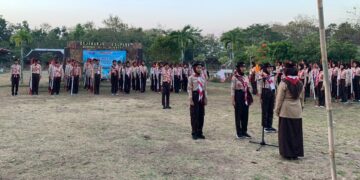
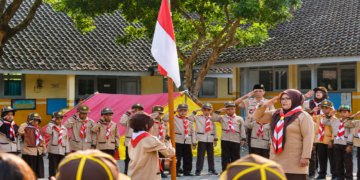


Inilah Pidato Kak Sultan Hamengku Buwono (HB) IX yang disampaikan pada Konferensi Kepanduan Dunia ke-23 di Tokyo tahun 1971, yang telah dimuat dalam Buku “Patah Tumbuh Hilang Berganti” Kwartir Nasional Gerakan Pramuka, tahun 1987.
Pidato Kak Sultan HB IX ini juga dipublikasikan di website ensiklopediapramuka.com, September 2012 dengan mencantumkan sumber.
Berikut pidato lengkapnya,
Scout Action for Community Development
by Hamengku Buwono IX
Dear Brother Scouter!
I welcome the opportunity of addressing this World Conference on “Scouting for Development”.
I am particularly happy to do it for two main reasons. First, because the subject of my address, namely the role of youth in community development, is very close to my heart. And secondly, because it is an honor for the Gerakan Pramuka and for my country to be able to contribute, whenever possible, in our modest way, to the great efforts of individuals, associations and nations, in the creation of better conditions for human development. I am grateful for your confidence, and I have the feeling that I can best acknowledge it by speaking my mind to this distinguished assembly frankly and realistically.
First of all, let me say how happy we are with the new trends in World Scouting. That is, with its development- oriented tendencies. We are even convinced that it is the only way of survival for Scouting as a word movement.
In the Third World we were confronted with a basic difficulty; how to assimilate a movement, which was very obviously the product of other traditions, which responded to other needs, and which was animated by other aims, without betraying its fundamental principles and values?
Considering that in our countries Scouting does not arise spontaneously from the aspirations of our youngsters, or from a felt need of our societies, the only way of getting it to survive was, and still is, to continue its updating and adaptation in accordance with the aspirations of our youth and the needs of our societies.
However, this acclimatization, this naturalization of a foreign movement, is only half the problem. The other half is the necessity to conserve its identity and its universality, since Scouting cannot survive as a simple juxtaposition of over one hundred national scouts associations, but must conserve an indispensable common basis in order to safeguard its specificity as a world brotherhood.
Since its creation, Scouting has always had a common-value system, voluntarily accepted by its members, and we can all agree on this key statement of Baden-Powell:
“The aim of Scout training is to improve the standard of our future citizenhood, especially in character and health; to replace self by service; to make the leads individually efficient, morally and physically, with the object of using that efficiency for service for their fellowmen”.
I sincerely believe that even during the three remaining decades of the twentieth century, our movement can and should abide by this statement. The real loyalty to B.-P. and to our traditions resides not in insisting on knotting and signalization (Semaphore), or in sending our boys to the forest to play Indians, but in helping them to become honest, efficient, loyal and responsible citizens. Not only of their own community and their own country, but of the whole world.
Indeed, today’s youth feels concerned about the future of the world as a whole. And a feeling of international solidarity and common responsibility is binding young people together from both the rich and poor countries.
If there exist world problems in which the involvement of youth could be very helpful, they are certainly the problem of development and all the questions related to the environment.
Development and ecology are definitely among the major issues that children of today shall be faced with during their whole life. The education they receive, as well as such out-of-school activities as Scouting must therefore help them, and prepare them to meet this inescapable challenge.
Today it has become generally accepted that development, and particularly community development, is inconceivable without the direct involvement of youth. The reasons for this are clear: development is a question of change from one situation to another; by definition a change from a worse to a better condition, whether in the standard or the quality of living. This can only be done with youth, who are tomorrow’s leaders. Moreover, development must involve youth for a purely quantitative reason: youth constitutes the majority of the world’s population today.
However, our awareness of these obvious factors must not lead us to overestimate our forces and our possibilities. The problems of development, and the safeguard of the life space for mankind on earth as an ecological whole, are world issues.
Some of their aspects can be solved only at the world level. Others can and should be solved on the level of the rich industrialized countries. Still others must be solved at the level of the developing countries. It is certainly not the duty of this conference to elaborate a world strategy or a world programme to solve the problems of development and conservation. But it is certainly our duty to educate for good citizenship, and to create skilled, honest, physically strong, and mentally alert individuals, who will work unselfishly to solve these great problems.
We, in Indonesia, have introduced during the past years a series of measures, and undertaken a number of experiences and concrete projects, all of which are directed towards giving the Scout movement in Indonesia a more and more nation-building-minded orientation.
Although we have failed at times, we have also succeeded in many respects. We have been, and still are, frankly open to the outside world, and we are grateful for its contribution. But above all, we have learned that in the final analysis our problems must be understood and solved by ourselves within the framework of our own country.
We are of course perfectly aware of the advantages of a worldwide strategy and collaboration, but we are also conscious of the fact that the decisive battles of development shall not be won in the far-off international centers in New York, Paris, or Geneva, but on the spot, that is to say, at the level of the nation itself. The rich countries can give money, they can help to teach techniques, they can help to organize. But they cannot export the determination and the people living in the developing countries.
Consequently, we must try to do our best to face the problems of development on the spot in the most concrete and most pragmatic way possible.
We know that the effort of the Indonesian Scouts is only a drop of water in the vast sea of needs of our country. But we are also aware that if we continue along the same path, and with a close collaboration with you and youth all over the world, we can become not only one factor, but perhaps the decisive factor, the motivating force of our development effort.
Following this rather theoretical introduction, I would like to give you some concrete and illustrated examples of what is actually being done in this respect in Indonesia.
(slides)
These few slides showed, as you have undoubtedly noticed, an overwhelming majority of pictures of the countryside. This is by no means accidental. In my country and certainly in other developing countries, national development calls in the first place for rural development.
Now, while everybody seems convinced of this, the fact remains that attempts to integrate the rural youth into the planning and implementation of rural development programmes, have been fragmentary. We must integrate rural youth more and more in the development of rural communities, not only to facilitate the growth of agricultural production by the introduction of new agrarian techniques, but also to make rural life more pleasant, more comfortable, more agreeable.
A more attractive rural life can divert youth from exodus towards the capital and the big cities. In my country the rural exodus of youth is a real menace and I think that the improvement of our activities in rural communities is the best preventive measure against the difficulties of integrating into urban societies the thousands and thousands youngsters. These youngsters, torn and uprooted from their traditional social sphere and their traditional yaw art & invade the cities, where, unprepared and unarmed as they are, they become the victims of inadequate, unemployment, organized juvenile deliquency, prostitution,
Therefore, I believe that community development applied to rural communities must have priority. This does not mean that we must neglect urban community development. The needs of the big cities are unlimited, but the problems arising in this field are very different from those arising in the countryside, which means that we must use different techniques. However, although both types of community development are different, they nevertheless have identical basic principles.
The most important of these basic principles is that community development, whether rural or urban, is not an imposed project, but a self-helf one. The helping hands of young Scouts should not be conceived in terms of free or cheap manpower, or as a simple sign of their participation.
Young people must be involved not only in the implementation of community development projects, but also in the planning and in the evaluation of the projects. Our movement is an educational movement, and our first goal is educational. The accomplishment of the project is essential, but equally essential is that the young people identify themselves with its realization, and can say : “This read, this dam, we have built ourselves!”
Another important rule of successful community development work is the involvement of the local population. The ideal situation is of course when a project is the initiative of the recipient beneficiary community; or at least of the youngsters, the Scouts of that community. But even a project proposed from outside can obtain the participation and involvement of the recipient community, provided an adequate parallel effort of information and education is made.
In conclusion, I would like once more to emphasize that really successful development work should not only lead to increased production. Its final aim consists in creating and developing a harmonious society. The involvement of Scouts in this nation-building effort is an indispensable condition for the survival of Scouting as a world organization. We can remain faithful to the basic moral principles of Scouting, but we must update our programmes in accordance with the aspirations of our youth, and with the needs of our society.
When I was a young boy, youth work consisted of the efforts of older people doing something for younger people. By contrast, in Scouting, self-education has always been the basic pedagogical principle. The community-development approach is ideally suited for Scout education. Certainly we, the leaders, must help the young people with our knowledge, our experience, and our material resources. But the problems must be solved by the boys themselves. If during long decades Scouting was a movement for boys, today scouting involved the active participation of the boys themselves.
Self-help, involvement, continuous training, and an effort to respect the real local needs, are the pillars of a successful community development work.
Thank you !